

Learn what a PM WANI PDOA is, how a Public Data Office Aggregator works, what registration and certification steps are involved, and why PDOAs are a core part of the PM-WANI public Wi‑Fi ecosystem.
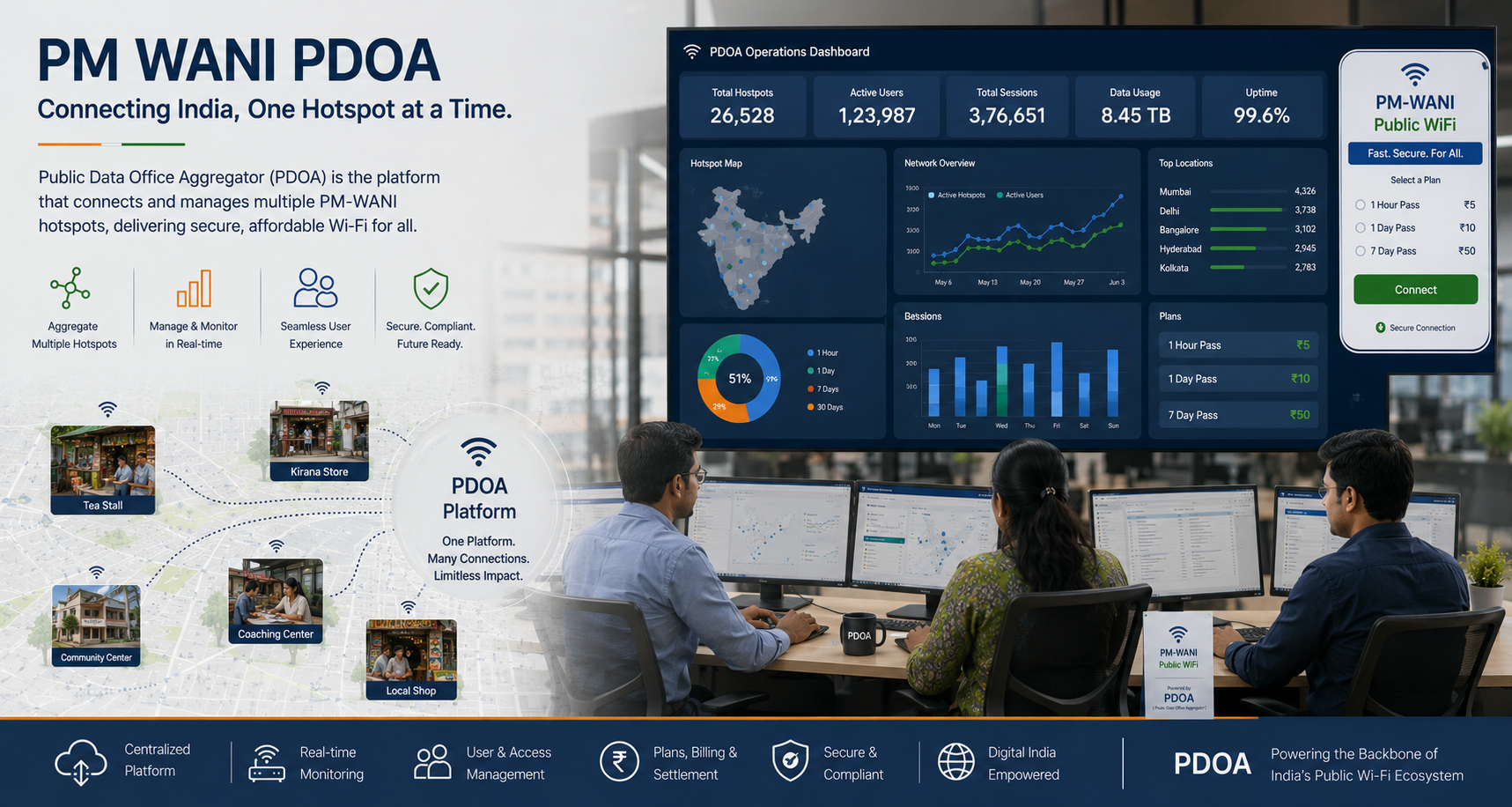
A PM WANI PDOA, or Public Data Office Aggregator, is a key service layer in the PM-WANI ecosystem. According to the PDOA booklet, a PDOA acts as an aggregator of multiple PDO access points and supports the broader structure through plan handling, user interface delivery, accounting, authorization, and captive portal services.
In simple terms, the PM WANI PDOA is not just a single hotspot location. It is the system layer that connects multiple local Wi‑Fi points, helps users buy internet plans, and enables PDOs to function within a coordinated PM-WANI service framework.
This page is designed to simplify the PM WANI PDOA concept for founders, technical teams, startups, and businesses that want to understand the registration, software, certification, security, and commercial structure behind PDOA operations.
The PDOA booklet explains that a PM WANI PDOA aggregates multiple PDOs that operate last-mile public Wi‑Fi hotspots. It compares the aggregator model to platform-style service structures where multiple independent providers are connected under one service framework.
A PDOA provides the user interface through which users can buy plans and monitor data usage. It also supports accounting, authorization, captive portal functions, and related operational features for PDOs connected to its platform.
This makes the PM WANI PDOA an important backend and service orchestration layer inside the public Wi‑Fi model. While PDOs are the local hotspot points, PDOAs create the broader platform that helps make service delivery practical and manageable at scale.
A PDOA connects and supports multiple last-mile public Wi‑Fi access points within one service framework.
PDOAs handle plan display, authorization, accounting, and portal-driven service interaction for users and PDOs.
The PDOA is the platform and coordination layer that helps multiple PDO hotspots function within the PM-WANI ecosystem.
User Plan Interface
Lets users buy plans and track usage
PDO Aggregation
Supports multiple hotspot operators on one platform
Authorization Layer
Handles accounting, portal flow, and access support
The PDOA booklet lays out a clear onboarding path. It says a PDOA should register at the Saral Sanchar Portal, register at the Central Registry, deploy PM-WANI compliant PDOA software, apply for certification, and then configure details at the Central Registry including security certificate and access point information.
Register on Saral Sanchar
Begin the PDOA registration path using the official telecom portal.
Sign up on Central Registry
Use the PM-WANI Central Registry to continue the onboarding flow.
Deploy compliant PDOA software
Set up PM-WANI compliant software before certification and configuration.
Apply for certification
Proceed through certification steps required inside the PM-WANI process.
Configure final registry details
Add security certificate and access point-related information.
Use official manuals
The booklet points users to PM-WANI downloads and manuals for the detailed onboarding process.
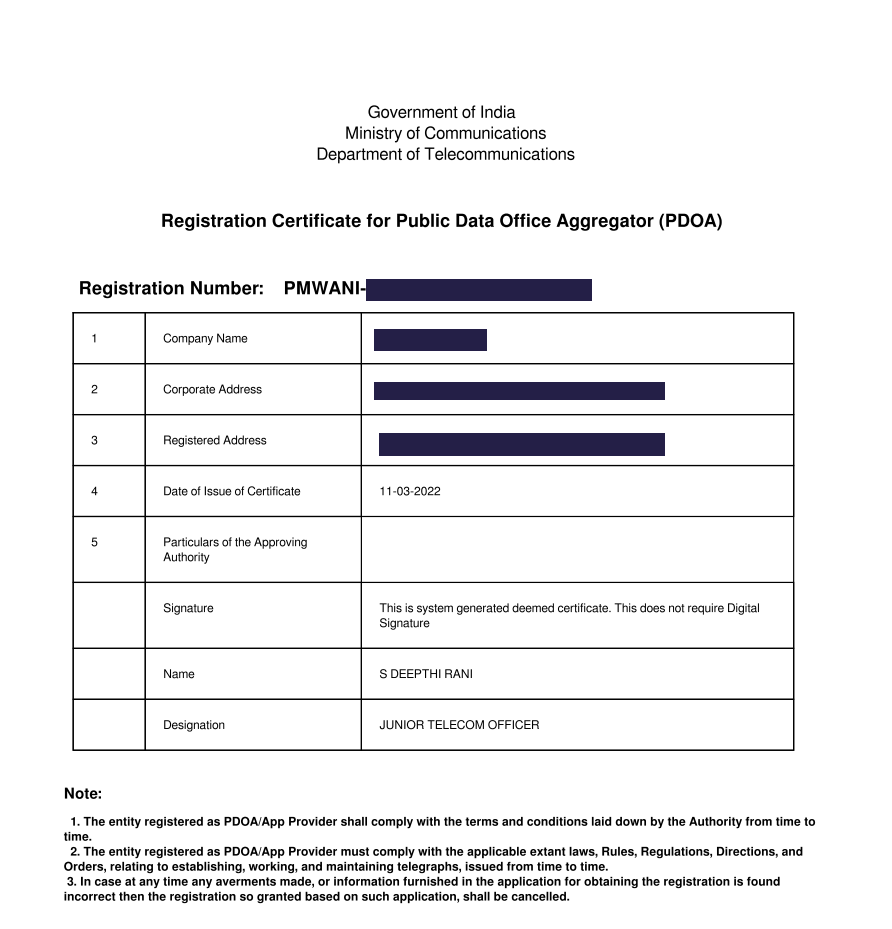
Below is the uploaded certificate example showing how a PDOA registration certificate can appear visually. Your uploaded image shows a government-style registration certificate format for a Public Data Office Aggregator with registration number, company details, certificate date, approving authority section, and compliance notes.
This is useful for trust-building on the page because it helps visitors understand that PDOA onboarding is tied to formal registration and certification workflows rather than just informal setup steps.
The certificate image is shown here only as an informational example. Users should always verify their own registration, approval, and certification status through official PM-WANI and government portals.
The PDOA booklet says a PDOA can procure PM-WANI certified PDOA software from the market, and C-DOT also provides PM-WANI compatible PDOA software.
PM-WANI compliant PDOA software is required
Provisional certification begins on self-declaration
User data and usage logs must be stored within India
🔒 Important Disclaimer
This PM WANI PDOA page is an independent informational guide and not an official government portal. Users should verify registration, certification, software, and compliance details through official PM-WANI sources.
The PDOA booklet defines the PDOA as an aggregator of multiple PDO access points that provide last-mile public Wi‑Fi services.
A PDOA provides the user interface for buying plans, tracking data usage, and handling accounting, authorization, and captive portal functions.
The booklet says the onboarding flow begins with Saral Sanchar registration and then Central Registry signup.
A PDOA begins with provisional certification on self-declaration and later requires certification through the designated lab process.
The PDOA booklet explains that revenue depends on the number of PDOs served, with revenue sharing based on agreement terms between PDOA and PDO.
The PDOA booklet explains that the main PDOA investment is in creating or sourcing the backend system for internet plans, authorization and accounting, payment collection, WANI token handling, and lawful interception-related logging support. It also describes both ownership and subscription-style operating models for infrastructure and software.
The booklet further says that a PDOA collects user payments through its portal when a user accesses a PDO hotspot and selects a coupon or plan. Revenue is then shared between PDOA and PDO according to their agreement, and the booklet notes that more PDOs served generally means more earning potential for the PDOA.
After learning about PM WANI PDOA, visitors can move into official registration pathways, Central Registry resources, and related PM-WANI stakeholder guides. This creates a clearer path from understanding the PDOA role to exploring registration, certification, and next-step research.
Register on Saral Sanchar
Start the official PDOA registration journey on the telecom portal.
Open PDOA Registry Page
Continue the PDOA process through the PM-WANI Central Registry.
Visit PM-WANI Portal
Use the official portal for downloads, manuals, and central resources.
Explore PDO Guide
Understand the last-mile hotspot role that PDOAs aggregate and support.
Understand App Providers
See how user discovery and access work alongside PDOA operations.
Contact Us
Reach out if you need help finding the right PM-WANI learning page.